Where's My Seat?・Logic Puzzles
- 4.7
- Rating
- 1.00M
- Installs
- Free
- Price

 Analysis by App-foxy
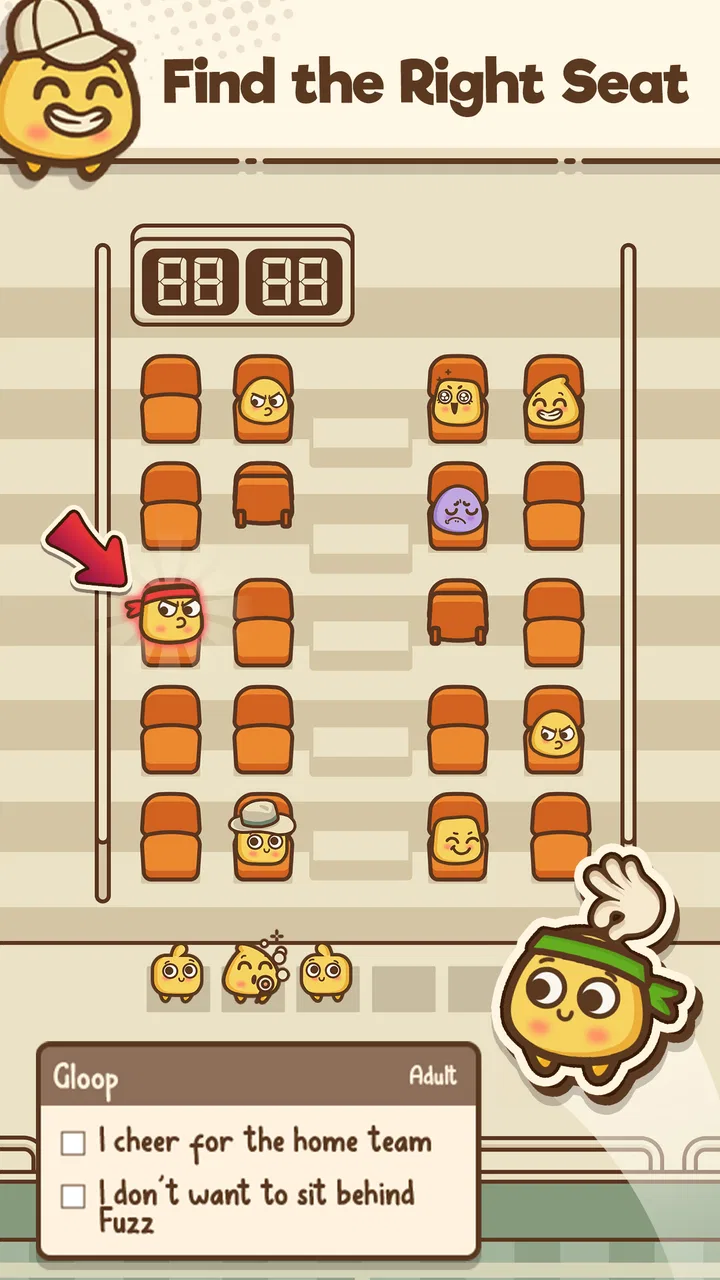
I spent time with Where's My Seat?・Logic Puzzles, a free puzzle game from Smartmove Global that turns seating arrangements into short logic challenges. The central idea is simple: read a set of clues, work out where each person belongs, and complete the seating plan. What makes the game worth considering is not a large collection of unrelated mini-games, but the way one verified capability—clue-based seating logic—changes a familiar brain teaser into something I can solve in small, focused sessions.
That focus gives the game a clear identity. It is not trying to be a general entertainment app with a puzzle section hidden inside it. Every challenge asks me to interpret relationships, positions, and restrictions before making a decision. In my experience, that makes each completed arrangement feel more satisfying than simply matching colors or tapping the next obvious move. The game is free to start, rated for Everyone, and listed with a 4.7 average from around 2.5 thousand ratings, so it has already found an audience among people who enjoy this particular style of reasoning.
Why the seating-puzzle idea works
The strongest part of the game is the way it turns language into a visible arrangement. A clue may tell me that one person sits beside another, that someone must be placed at an end, or that two people cannot be together. Instead of solving a number sequence or clearing a board, I have to translate those statements into a seating plan. That extra step is where the challenge lives.
You May Also Like

 Blood Strike: 2.5 Anniversary
Blood Strike’s Loadouts Turn Every Drop Into a Tactical Gamble
A close look at Blood Strike’s custom loadouts: how fast access to signature weapons reshapes its battle royale rhythm, rewards preparation, and narrows the gap between fights.

 Pandora - Music & Podcasts
Pandora’s Music Is Easy to Start, but Harder to Recover
Pandora’s strength is its low-effort path from a seed to a station. Its weak spot is how much confidence it asks you to place in connection, setup, and quiet recovery.

 8 Ball Pool
 Is Built on Rivalries, Rematches, and Routine
A close look at the rivalries, rematches, shared routines, and unanswered safety questions that turn a quick pool match into a persistent mobile community.

 Samsung Music
’s Quiet Strength Is Playing What You Already Own
Its reach comes less from spectacle than from dependable access to a personal library. That simplicity is both the app’s strongest retention engine and its ceiling.

 AccuWeather: Weather Radar
AccuWeather Review: A Quick, Clear Forecast for Everyday Decisions
For everyday plans, the best forecast is the one you can understand quickly. AccuWeather makes rain timing, radar, and local conditions easy to act on, with a few trade-offs.

 Hill Climb Racing
Why Hill Climb Racing Still Turns Crashes Into One More Run
A tiny car, a bumpy hill and one more upgrade: Hill Climb Racing keeps resurfacing because its simple chaos makes every near-miss feel personal.
More From Our News Desk



I like this format because it rewards organization rather than speed. I can pause, reread a clue, and test a possibility without feeling that the game is demanding quick reflexes. The useful mental shift is to stop treating every clue as an isolated instruction. A single fixed position can affect several other seats, while a “not beside” rule may become much more valuable after two neighboring places are confirmed.
The real capability is clue management, not fast tapping. That distinction matters when deciding whether this game suits you. If you enjoy deduction grids, arrangement riddles, and problems where one fact unlocks another, the seating format gives you a compact version of that experience. If you prefer action, visual effects, or instant rewards, the same deliberate pace may feel slow.
The game’s short description, “Where's My Seat?”, captures the question at the center of every puzzle, but the actual appeal is the reasoning behind the answer. I am not merely searching for an empty chair. I am building a consistent explanation from several clues, and the final placement only feels correct when the whole arrangement fits.
How I approach each puzzle
My most reliable method is to begin with the strongest clue rather than the most interesting one. A direct placement, an end position, or a clear separation rule usually gives me a useful anchor. Once that anchor is established, I look for clues that mention the same person or nearby seats. This reduces the number of possibilities before I start guessing.
I also found it helpful to separate certainty from possibility. If a clue proves that someone must occupy a particular place, I treat it differently from a clue that merely leaves two possible seats. Holding those two kinds of information apart prevents a common mistake: mentally promoting a likely answer into a confirmed one and then building the rest of the arrangement on it.
When I get stuck, I do not immediately restart. I review the arrangement from the beginning and ask which placement was based on an assumption rather than a direct deduction. This is a practical habit for this game because seating puzzles can appear nearly complete while still containing one incorrect early choice. Rechecking the first uncertain step is often more useful than staring at the final empty space.
Another useful technique is to work from constraints that interact. A clue saying that two people cannot sit together may seem weak at first. It becomes powerful when one of those people is placed near the edge, because the available neighboring positions shrink. Similarly, a relationship involving a central seat can affect both sides of the arrangement. Thinking about the board as a network of restrictions makes the clues easier to combine.
I would not describe the experience as a pure memory test. The challenge is more about keeping a clean chain of reasoning. That makes it approachable for players who like logic but do not want complicated mathematics. It also means the game can expose sloppy thinking: if I rush, I tend to overlook how a small placement changes the meaning of later clues.
What the game feels like in everyday use
The best everyday scenario for me is a short break when I want something more engaging than scrolling but do not have the attention for a long game. I can open a puzzle, read the clues, and work through the arrangement at my own pace. It fits a waiting room, a commute when I am seated, or a quiet pause between tasks better than a game that expects continuous action.
There is also a useful social angle, even though the solving itself is individual. I can show a puzzle to a friend and compare how we interpret the clues. One person may begin with positions while another starts with exclusions, and discussing those approaches makes the logic visible. That makes the game a reasonable choice for families or casual puzzle fans who want a shared problem without needing a competitive multiplayer mode.
For younger players, the Everyone rating makes the content broadly accessible, but I would still judge suitability by reading ability and patience. The difficulty is not based on mature themes; it comes from understanding language and following several conditions at once. A child who enjoys riddles may find it rewarding, while a player who becomes frustrated by rereading instructions may need guidance at the beginning.
For adults, the value is less about learning a new system and more about having a focused mental exercise that is easy to start. I would use it when I want a puzzle with a clear finish line. It does not require me to remember a large story or maintain a complicated collection. The immediate task is always the arrangement in front of me.
Where it differs from familiar puzzle alternatives
Compared with match-three games, this title gives me less instant visual feedback but more room for deliberate thought. A match-three board usually rewards recognizing patterns quickly and acting before the board changes. Here, the important move may be doing nothing for a moment and examining the wording of a clue. Players who enjoy planning will probably appreciate that difference; players who want constant movement may not.
Compared with crossword-style games, the emphasis is also different. A crossword tests vocabulary and intersecting answers, while these seating puzzles test relationships and positions. Knowing a word is not enough here. I need to understand how one person’s placement limits another person’s options. That makes the game a better fit for arrangement problems than for language practice.
Deduction-grid apps are the closest alternative. Those often present several categories in a table, such as people, places, and times, and ask the player to mark possibilities. Where's My Seat? narrows that style into a seating-focused problem. The benefit is a cleaner theme and a more immediate visual goal. The trade-off is that anyone looking for broad logic-grid variety may eventually prefer a larger collection of puzzle types.
Traditional paper logic puzzles still have one advantage: I can annotate every possibility freely. On a phone, I am more dependent on the game’s presentation and on my own mental notes. That is not a flaw in the core idea, but it affects how I play. If I like drawing elaborate grids or marking every rejected option, a notebook beside the phone may make difficult puzzles easier to manage.
Practical strengths, friction, and the right player
I’ll focus on the practical trade-off: the seating format gives each puzzle a clear, bounded goal, but the same narrow focus may matter more to some players than the headline rating. I’d use a simple check before settling in—do I feel like translating written clues into positions, or do I want a puzzle with faster visual feedback? That distinction helps explain which strengths and friction points deserve attention.
The trade-off between clarity and challenge
The focused design is both the game’s biggest strength and its main limitation. Because the puzzles revolve around seating clues, I always know what kind of thinking is expected. I do not have to learn a new mechanic before every level. That clarity makes the game approachable, but it can also make the experience feel repetitive for players who need constant variety.
The wording of a clue carries unusual weight in this format. A small misunderstanding can send the entire arrangement in the wrong direction, so I recommend reading each condition slowly instead of tapping through it. This is especially important when several clues use similar relationships. The game is most enjoyable when I treat the text as part of the puzzle rather than as instructions to skim.
Another trade-off is that the satisfaction comes after the reasoning, not during every action. There may be stretches where I make no visible progress because I am comparing two possible placements. That quiet period is valuable for a logic fan, but it can feel like a lack of momentum to someone accustomed to constant rewards.
In-app purchases range from $0.99 to $99.99 per item. Since the game is free, I would approach those optional purchases carefully and decide whether they genuinely improve my experience before spending. For a puzzle title, the important question is whether I enjoy solving the clues without relying on assistance. Paying should not replace the central reasoning that makes the game worthwhile.
Small habits that make difficult arrangements easier
My first practical tip is to identify the clue with the fewest possible outcomes. “At an end” is usually more useful than a broad statement about being somewhere in the row. If two people must be adjacent, I keep them as a temporary pair until another clue separates or fixes them. This reduces the number of individual placements I need to consider.
My second tip is to test contradictions early. If a proposed arrangement forces two people into a forbidden neighboring position, I discard that branch immediately rather than trying to repair it later. This saves time and keeps the puzzle from becoming a collection of half-correct guesses.
My third tip is to use the edges strategically. End seats have fewer neighbors, which makes adjacency clues behave differently there than in the middle. When a clue involves sitting beside someone, checking whether an edge placement would leave enough room can eliminate possibilities before I work through the entire layout.
A fourth useful habit is to solve in passes. On the first pass, I look only for fixed positions and obvious pairs. On the second, I apply exclusions. On the third, I verify every clue against the completed arrangement. This final verification is important because reaching a full seating plan does not automatically mean every condition has been satisfied.
Who will gain the most from it
I would recommend this game to people who enjoy calm, text-driven puzzles and want a phone-friendly way to practice structured reasoning. It is particularly suitable for players who like solving one defined problem at a time, rather than managing a large campaign or collecting upgrades. The free entry point also makes it easy to try without committing to a paid puzzle package.
It may also suit parents looking for a shared reasoning activity that does not depend on violence or complicated controls. The Everyone rating supports that broad audience, while the clue-based format creates opportunities to explain how deductions work. I would still play alongside younger children at first, because the challenge is likely to be interpreting the wording rather than operating the device.
People who want a quick mental reset may appreciate the game more than those seeking a deep long-term system. Its value is concentrated in the puzzle itself. I can use it for a few minutes, stop after a solution, and return later without needing to remember a story or maintain a strategic build.
On the other hand, I would skip it if my ideal puzzle game depends on constant novelty, rich narrative, or tactile board manipulation. A sudoku app is better for number-based deduction, a word game is better for vocabulary, and a broad logic collection is better if I want several puzzle formats in one place. This title earns its place by doing seating logic specifically, not by covering every possible kind of brain teaser.
Device requirements and version context
The game runs on Android devices using version 7.0 or later, which gives it a relatively broad reach among compatible phones and tablets. The current version is 1.1.8, so I would keep the app updated through the normal store process to receive the version intended by Smartmove Global. The practical point is simple: check the operating-system requirement before installing on an older device.
With over one million installs, it is not an obscure experiment, and the strong average rating suggests that the central puzzle idea connects with many players. Still, popularity should not decide the purchase question for you. The important test is whether you enjoy reading several clues, preserving partial deductions, and accepting a slower rhythm while the arrangement comes together.
My recommendation after playing
Where's My Seat?・Logic Puzzles works because it commits to one clear capability: turning verbal clues into seating decisions. I found that focus more meaningful than a collection of shallow mechanics. The game encourages me to slow down, distinguish facts from guesses, and verify the whole arrangement instead of celebrating the first plausible answer.
Its limitations are equally clear. The format may feel narrow, the text demands concentration, and players who want rapid action or broad variety will likely be happier elsewhere. The in-app purchase range also means I would treat optional spending as a personal choice rather than an automatic part of the experience.
For me, the best reason to try it is that it makes a familiar logic exercise convenient without stripping away the reasoning. I can approach a puzzle during a short break, use a structured method when I am stuck, and finish with a solution that feels earned. If that sounds more appealing than tapping through a fast arcade loop, Smartmove Global’s game is a worthwhile free puzzle to put on your phone.
FAQs for Where's My Seat?・Logic Puzzles
01What is Where's My Seat?・Logic Puzzles all about?
Where's My Seat?・Logic Puzzles is a brain-teasing app designed to test your logical thinking and problem-solving skills. The game involves arranging seats in a variety of challenging scenarios, each with its own set of rules and constraints. It's perfect for puzzle enthusiasts looking for a fun and engaging way to exercise their minds.
02Is Where's My Seat?・Logic Puzzles suitable for all ages?
Yes, the app is suitable for all ages, offering a range of difficulty levels to cater to both beginners and advanced players. The intuitive interface and simple controls make it accessible for younger users, while the increasing complexity of puzzles ensures that adults and seasoned gamers remain engaged.
03Does the game require an internet connection to play?
Where's My Seat?・Logic Puzzles can be played both online and offline. While an internet connection is needed to download new levels and updates, the core gameplay can be enjoyed without any connectivity, making it a great option for on-the-go entertainment without worrying about data usage.
04Are there any in-app purchases or ads in Where's My Seat?・Logic Puzzles?
The app offers a free version with ads and optional in-app purchases to enhance the gaming experience. Players can choose to purchase additional level packs or ad-free gameplay. This allows users to enjoy the game for free while also having the option to support the developers and unlock premium content.
05How often are new puzzles added to the app?
New puzzles are added regularly to keep the experience fresh and exciting. The developers are committed to providing continuous content updates, ensuring players always have new challenges to tackle. Updates are typically released monthly, with notifications keeping players informed about the latest additions.
Pros
- Engaging puzzles that challenge your logic.
- Colorful graphics enhance user experience.
- Intuitive controls make it easy to navigate.
- Regular updates with new puzzles.
- No intrusive ads to disrupt gameplay.
Cons
- Limited hints can be frustrating at times.
- Requires internet connection for updates.
- Some puzzles feel repetitive over time.
- Occasional bugs in older device models.
- Lacks multiplayer or social sharing features.

Where's My Seat?・Logic Puzzles
Gallery